




By Jack Mercer – Rabbit Hole Fisherman
The horse gets a rest day.
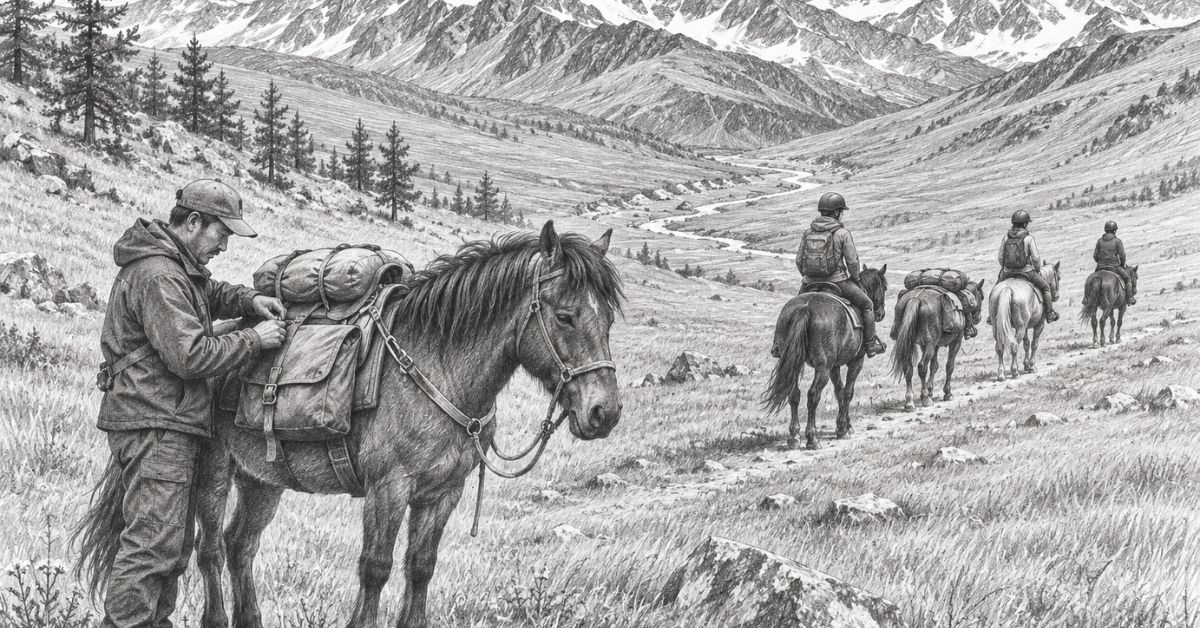
In the sample itinerary for a long ride through Mongolia’s Altai Mountains, it arrives after days of climbing into country where supplies travel on pack animals. The riders can walk, read or sit around. The horses have work to recover from.
In This Story
- Ölgii and the route
- Riders, wranglers and local knowledge
- Life on the trail
- The wider Altai landscape
- Practicalities and horse welfare
It is an appealing detail in a journey otherwise easily reduced to grand views and galloping. A horse carries you into the mountains, but it also gives the trip a limit that has nothing to do with your enthusiasm. Distance has to be earned by an animal as well as a person.
That makes this adventure unusually companionable. Your transport has preferences.
Ölgii and the route
The starting point is Ölgii, the town in Mongolia’s far west whose name appears in several English spellings, including Ulgii and Olgii. The surrounding Bayan-Ölgii province is predominantly Kazakh. Arriving here means encountering a part of Mongolia that complicates the shorthand images of the country: local language and family histories deserve attention alongside the national flag.
The mountains supply plenty of distraction. Mongolia’s 2014 submission to UNESCO’s World Heritage Tentative List describes high ridges descending into dry steppe and great basins, with lakes and patches of forest within the wider highland landscape. Altai Tavan Bogd National Park reaches Mongolia’s borders with China and Russia.
There are several ways to ride through it. For this journey, the useful model is the southern route advertised by Zavkhan Trekking, travelling from Ölgii towards Altai village and Chigertei Lake, then into the Yolt country. Its published plan allows roughly a fortnight of riding and exploration. Vehicle support eventually gives way to packhorses or camels. The exact route depends on conditions.
The change of transport matters more than a line on the map. Beyond vehicle access, every piece of camping equipment becomes something that must be loaded, carried and unloaded. The freedom to keep going comes with a daily packing job.
Matching horse and rider
Before any of that, someone has to decide which horse you should ride.
Zavkhan’s general guidance says riders are matched to suitable horses, with instruction in local riding techniques. It describes around six hours in the saddle as a usual target across its trips, with breaks, while stressing that terrain changes the day’s progress. Those hours are worth considering from the comfort of a chair. Sitting on a horse requires rather more involvement than sitting on a chair.
A beginner may be occupied with keeping a sensible seat and understanding the instructions. An experienced rider brings different habits, some of which may need adjusting to unfamiliar tack or a new horse. There is little advantage in arriving determined to demonstrate expertise. The people providing the horses have knowledge you have come to borrow.
Riders, wranglers and local knowledge
New Zealand writer Ian D. Robinson described a ride here in a July 2014 article for Kansai Scene. His party travelled with a Kazakh family whose members worked as wranglers, cook and translator. He named Amangul, Onorbek and Mizenkhan among the people accompanying them, and described riders consulting the wranglers about the route as the trip progressed.
That arrangement gives a different meaning to an exploratory holiday. Visitors can have preferences about where to go. The wranglers contribute the experience that makes those preferences worth discussing.
Robinson’s account is an older journey, rather than a timetable for a departure today. It is useful because it puts people into the picture: individuals making decisions, finding a way through and travelling with their children. The mountains become a place where somebody knows what they are doing.
Another published account, Liz Carlson’s 2014 Young Adventuress article, describes her efforts to learn Kazakh words from wrangler Khadaran. A translator, Anar, travelled with the group. Carlson also wrote about the practical help she received as a developing rider, including assistance at the end of long days.
Language learning seems particularly well suited to travelling beside someone at walking pace. There is time to repeat a word badly, forget it and ask again. A ridge remains in view long enough to have several attempts at naming it.
Carlson’s account also identifies Amangul as the person managing the trip. Zavkhan’s team page lists her in that role for its journeys in western Mongolia and Kazakhstan, and mentions her singing and playing of the dombra.
It would be easy to leave her in the story as a provider of warm meals and evening music. Managing a travelling camp is a larger responsibility than that. The role belongs near the centre of an account of how this journey happens.
Life on the trail
There is some pleasure, too, in discovering how much of an adventure takes place between the supposed highlights. A conversation can occupy a stretch of valley. Learning to sit more comfortably may count as the morning’s achievement. By late afternoon, the campsite can matter more than whatever peak appeared most impressive at breakfast.
On the southern route, the advertised progression leads from open plains into mountain passes and wooded valleys. One stage reaches a base camp before further travel with pack animals. Later, the return involves steep switchbacks through a pass the operator has given a deliberately alarming name. Its own description explains that the name was coined on an earlier trip.
The actual terrain deserves attention without borrowing extra menace from the label. A steep descent is sufficient reason to listen carefully.
The pleasure of riding here includes the changing scale of the view. From the valley, a slope can seem to occupy most of the available world. Higher up, the route just travelled becomes a small piece of a much larger arrangement of ridges. The horse continues to require your attention through both perspectives. You cannot spend the entire day admiring the horizon.
The wider Altai landscape
For travellers who would rather explore the park’s northern glacier country and lake routes, local operators publish other combinations of riding and walking. Discover Kazakh Nomads, for example, describes a journey supported by local herders and pack camels, with visits to Tuvan households as well as Kazakh communities. This is another reason to be precise about a trip’s location. One family or valley cannot stand for the whole Altai.
The scale of human occupation extends much further back than any holiday route. The Petroglyphic Complexes of the Mongolian Altai, inscribed on the World Heritage List in 2011, comprise three separate areas of rock art and monuments. UNESCO describes a record spanning roughly 12,000 years, including changes from hunting to herding and later horse-dependent ways of life.
That history offers something substantial to think about from a saddle. Animals carved into rock survive their makers by millennia. They tell us that people paid close attention to the living things around them, although the meaning of any particular image requires archaeological knowledge rather than a traveller’s guess.
The three World Heritage areas are specific places. A carving encountered elsewhere on a ride should not acquire UNESCO status simply because it lies in the same mountain region. Nor does a modern herding family need to be described as a surviving fragment of prehistory. People can inherit knowledge and still live in the present.
Pasture, hospitality and music
Seasonal movement is part of that knowledge. UNESCO’s account of Mongol nomad migration and its associated practices, recognised as intangible cultural heritage in 2024, describes the relationship between pasture, livestock and herders. Families select pastures according to conditions including the season, climate and available grass.
The distinction between travelling through grazing country and depending on it is considerable. A visitor can like the view and move on. A household needs the land to feed its animals beyond the week of the visit. The question of where to camp belongs within that working landscape.
It also changes how hospitality should be understood. A stop at a family home brings you into somebody’s day. Introductions and translation help make an encounter possible, but buying a tour does not buy an unrestricted view of another person’s life. Ask before taking photographs, and let the hosts determine how a visit unfolds.
There may be music. The dombra, a long-necked instrument with two strings, has its own substantial tradition. UNESCO’s description of Kazakh traditional art of Dombra Kuy concerns short instrumental compositions, with knowledge passed between players and across generations. Hearing it at camp can prompt a better question than whether the evening feels sufficiently exotic: what is the musician playing?
Even a brief answer adds something a photograph cannot.
Practicalities and horse welfare
Horses bring the attention back to practical matters. Whatever a rider’s ambitions, their condition and workload deserve a place in the plan. A suitable match, sensible pace and time to recover are part of choosing a trip. It is reasonable to ask an organiser how those decisions are made, as well as how far the route goes.
Queensland’s workplace guidance on horse handling, written for a different setting, makes two principles plain: match the horse to the rider’s ability and size, and wear a correctly fitted riding helmet. Neither becomes less relevant because the surrounding mountains are beautiful.
Adventure also accommodates patience. A delay can leave time to watch the camp being packed, learn another word or discover how much you have been relying on somebody whose job title you had barely noticed. The experience of being a novice is part of the attraction, provided you are willing to admit to it.
The horse’s rest day is a useful opportunity to get down to its level. On foot, even a modest slope reminds you of what has been carrying your weight. You can take your time over the walk back to camp. Tomorrow’s route will ask enough of both of you.