




By Jack Mercer – Rabbit Hole Fisherman
Recorded in West Berlin in 1977, Heroes became one of David Bowie’s defining songs.
The famous kiss story remains contested, but the record’s sound and legacy still stand.
In This Story
- Berlin and Bowie
- The Hansa Studios sessions
- The sound of Heroes
- The disputed kiss story
- Chart history and legacy
- Bowie returns to Berlin
Berlin and Bowie
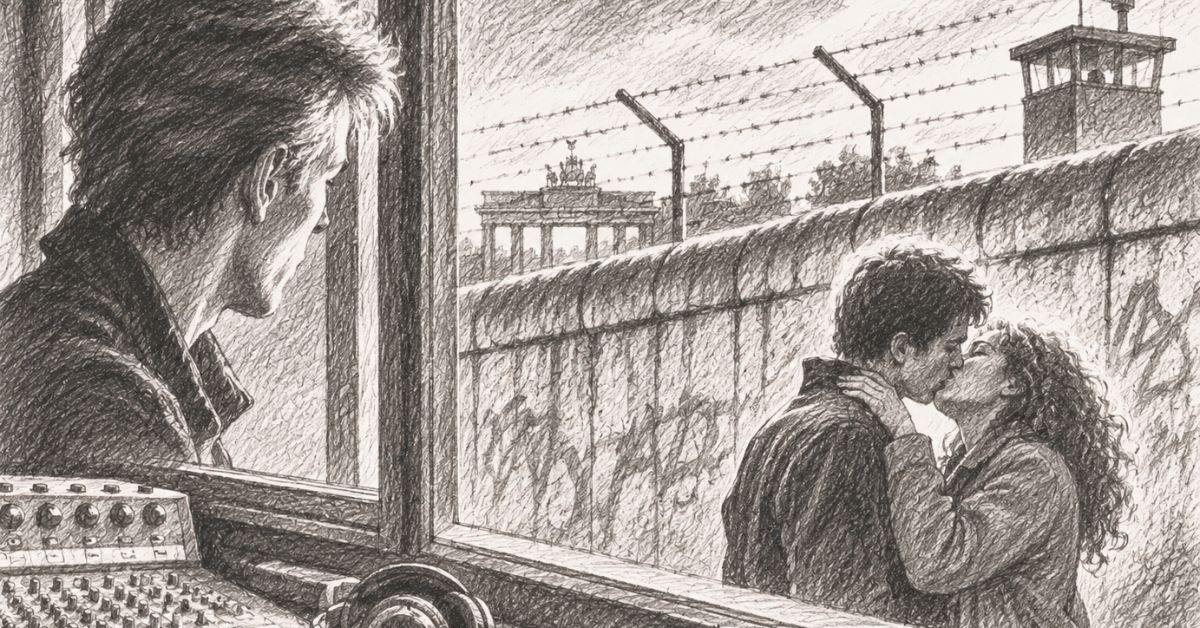
In 1977, David Bowie recorded Heroes at Hansa Studios in West Berlin. The studio sat near the Berlin Wall. The city shaped the session. One familiar story says Bowie saw Tony Visconti and Antonia Maass kiss nearby. That account remains disputed.
Still, the song carries Berlin’s atmosphere and Bowie’s ambition. The dispute never removed the record’s power.
By the mid-1970s, Bowie wanted cleaner habits and a different sound. He also wanted distance from Los Angeles. Berlin offered both privacy and tension. He worked there with Iggy Pop and Brian Eno. That period reshaped his career. The Berlin years became one of his most important creative stretches. He wanted a harder edge and less excess.
The Hansa Studios sessions
Heroes belonged to the Berlin Trilogy. It was the only one recorded entirely in Berlin. Hansa’s location mattered. The room was a former dance hall. Its long reverb changed the record’s feel. The building’s mood mattered as much as its acoustics. The wall loomed over the studio window.
The band built the track from ideas, not completed songs. Carlos Alomar played guitar.
George Murray played bass. Dennis Davis played drums. Robert Fripp later added the soaring lines. Brian Eno added texture too. Fripp’s guitar seems to hover above the rhythm. The result sounds controlled and open at once. It keeps unfolding as it plays.
The sound of Heroes
Tony Visconti shaped Bowie’s vocal sound with three microphones. He placed them at different distances. Noise gates opened as Bowie sang louder. The close mic caught the quiet lines. The distant mics added room echo. The performance grew wider as the song climbed. Visconti wanted the room to breathe with Bowie. The technique matched the song’s emotional rise.
The disputed kiss story
Visconti said Bowie left him alone with Maass for a walk. He said they kissed near the Wall. Maass later challenged the timeline. The safest reading treats the kiss as recollection, not fact. The story survives because it fits the music. That uncertainty does not weaken the song. It strengthens the legend around it. The chronology stays unclear, but the record stays compelling.
Chart history and legacy
On release, Heroes reached No. 24 on the UK singles chart. The album reached No. 3.
The single later gained far greater cultural weight. Its endurance came from emotional force, not immediate sales. Listeners kept returning to it. Radio programmers did not decide its long-term importance.
Bowie returns to Berlin
In 1987, Bowie returned to Berlin for an outdoor concert near the Reichstag. East Berliners gathered on the other side of the Wall. Police tried to hold them back.
Contemporary reports described tension and confrontation. The Washington Post reported clashes near the border. Bowie later called the night deeply moving. That concert linked the song to a city in flux. The moment added another layer to the song’s history.
Heroes endures because it joins memory, myth and performance. The disputed kiss matters. But the recording’s sound matters more. The song still feels larger than its parts.
Bowie and his collaborators built a track that keeps opening outward. That is why it remains one of his defining recordings. The music still feels urgent, intimate and vast.