




Redlands Area Sports Results 29-31 May 2026


FQPL1

 Sat, May 30, 2026 (Gabba, Brisbane) – Toyota AFL Premiership – Men – Round 12
• Brisbane Lions 78   |   Fremantle 103


HART Premier Netball League (HPNL)

Sun, May 31, 2026 (Nissan Arena) – HART Premier Netball League (HPNL) – Women – Round 4
• Redlands Coast Eagles Ruby 54   |   Kedron-Wavell Cougars Ruby 76


Restored Willards Farm Becomes a Living Link to Birkdale’s Early Years

Inside Willards Farm in Birkdale, visitors are finding more than a restored Queensland farmhouse. The heritage-listed property is giving Redlands Coast residents a rare chance to walk through one of the region’s last surviving farming homes while learning about the families, workers and communities connected to the land across generations.


Tours of the site began in May 2026 after years of restoration work led by Redland City Council. Guided by Council’s Library Local History Adviser, visitors move through the farmhouse and surrounding buildings while hearing stories linked to the property and the wider development of the Redlands district.

Photo Credit: RedlandCityCouncil/YouTube

Restoring one of Redlands’ last surviving farmhouses

When Redland City Council purchased Willards Farm in 2016, the farmhouse had deteriorated over time and required significant restoration to preserve the structure.

According to official council updates, heritage specialists worked to return the property as closely as possible to its earlier condition while protecting original features throughout the site.

The farmhouse is regarded as one of the last remaining examples of the area’s early farming history. Long before residential growth transformed much of the bayside region, properties such as Willards Farm formed part of the agricultural landscape that supported local communities.

Mayor Jos Mitchell stated that preserving the property would allow future generations to experience an important part of the region’s past firsthand.

Photo Credit: RedlandCityCouncil

Tours uncover stories behind the property

The first public tours focused not only on the restored buildings but also on the people whose lives were connected to the property. 

Tours place the farm within wider Queensland colonial history, including discussion of South Sea Islander labour and blackbirding during the 19th century. The term refers to the deceptive or forced recruitment of Pacific Islander labourers who were brought to parts of Australia during the colonial era.

Visitors are also introduced to local folklore connected to the property, including stories about a woman remembered in the district as the “Goat Lady”.

Together, the stories offer a broader picture of life in the region during a period when farming shaped much of the local economy and community life.

Farmhouse to become part of wider community precinct

Willards Farm sits within the Birkdale Community Precinct, where future community, cultural and environmental projects are planned. It is a future gateway to the precinct, linking the area’s history with new community spaces planned for the site in coming years.


Interest in the tours has highlighted strong community curiosity about places that connect present-day residents with the people and events that helped shape the Redlands Coast.


Published 29-May-2026

Featured Image Credit: RedlandCityCouncil

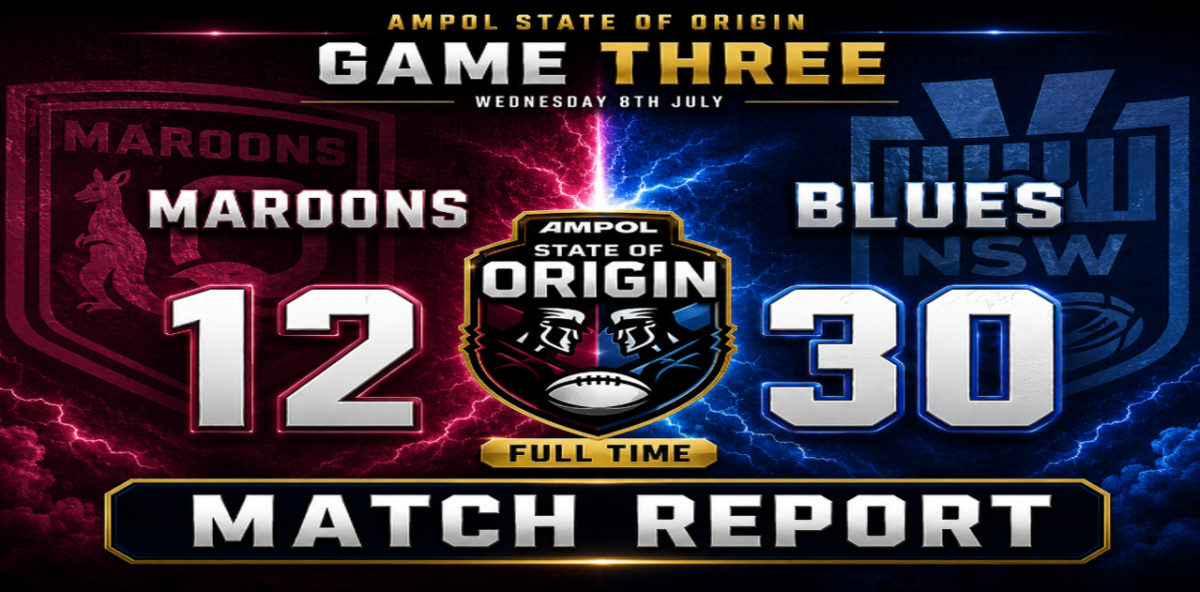
Maroons Heartbreak As Blues Rip Origin I Away In Stunning Sydney Comeback


MATCH REPORT

Published 27-May-2026


Devastating for the Maroons at Accor Stadium in Origin I.

Kalyn Ponga’s sending off in a decision that immediately sparked controversy proved an enormous turning point. Andrew Johns was critical of the decision during commentary. It swung hard-fought momentum against Queensland, and the Blues produced an extraordinary final-minute play, with James Tedesco catching, juggling and grounding Nathan Cleary’s bomb.

For much of the night, Queensland looked in control.

Not just ahead on the scoreboard — in control of the contest itself. Their line speed was sharp, their middle forwards were winning collisions, Harry Grant was asking questions around the ruck, and Sam Walker, on debut in the most pressurised arena the game can offer, looked remarkably composed.

Then Origin did what Origin does.

It twisted.

A night that had looked set to become a major statement for Billy Slater instead became a brutal lesson in how quickly interstate football can turn when momentum shifts and belief takes hold.

Queensland led 20-0 after 20 minutes. They were still 20-6 ahead deep into the second half. And yet somehow, they walked away beaten 22-20.

That is the sort of loss that lingers.

Queensland Landed Every Early Blow

If there were doubts about Ponga getting the nod over Reece Walsh, or whether Walker was ready for this level, Queensland answered them quickly.

Robert Toia struck first in the ninth minute after early pressure forced the Blues into errors, and Walker converted.

It got worse for New South Wales from there.

Thomas Flegler, all aggression and direct running, punched through in the 14th minute after Queensland had started owning the middle. Selwyn Cobbo had already done damage with a strong carry in the lead-up, and the Blues suddenly looked rattled.

A few minutes later, Hamiso Tabuai-Fidow crossed as Queensland continued to punish sloppy New South Wales football.

Walker never missed.

By the time he added a penalty goal in the 20th minute, the Maroons were 20-0 up, and Accor Stadium had gone from loud to uneasy.

Queensland weren’t just scoring. They were dictating the terms.

Munster was playing direct. Grant was probing. Tino Fa’asuamaleaui and Flegler were bending the line. Even defensively, the Maroons looked connected and aggressive.

At that point, it genuinely felt like the Blues were in serious trouble.

New South Wales Hang Around

Origin, though, rarely gives you a clean night.

Hudson Young’s try in the 27th minute finally gave the Blues something tangible to work with, trimming the margin to 20-6 after Cleary’s conversion.

Even then, Queensland still looked the more settled side.

They defended repeat pressure well enough and took that lead into half-time without looking especially rattled. But if you were watching closely, there were hints the game was changing shape.

The Blues had started to spend more time in Queensland territory. Their attack still lacked polish, but the game had become less comfortable than the scoreboard suggested.

And once that happens in Origin, strange things tend to follow.

The Turning Point That Changed Everything

The defining moment came just before the hour mark.

Ponga was sent off for a shoulder charge in a decision that immediately lit up debate.

Whether you agreed with it or not, the practical effect was obvious. Queensland suddenly had to survive a critical passage under enormous pressure, a man short, against a side that had finally found some rhythm.

The Blues took advantage.

Ethan Strange crossed in the 62nd minute after Stephen Crichton’s break opened the Maroons up, although Cleary’s missed conversion meant Queensland still had breathing room at 20-10.

But the feel of the match had changed completely.

The crowd sensed it. The Blues sensed it. Queensland, perhaps, sensed it too.

Cleary’s 40/20 in the 70th minute was the moment the pressure became suffocating. It was a champion’s play, the kind that flips field position and emotional momentum in one strike.

Seconds later, he backed it up by slicing through himself.

20-16.

Now the Maroons were no longer managing a lead. They were trying to survive.

Queensland Let The Game Slip

The temptation will be to make this all about the Ponga send-off.

It was enormous. Lose a player in Origin, against a side with Nathan Cleary pulling the strings, and the pressure changes instantly.

But Queensland still had chances to steady themselves.

Instead, just when composure mattered most, the mistakes crept in.

Robert Toia lost the ball. Harry Grant conceded a costly penalty. Selwyn Cobbo came up with an error. Jojo Fifita spilled possession.

None of those moments, on their own, decide a match.

Together, though, they handed New South Wales exactly what it needed — territory, repeat sets, and belief.

That’s how these games can turn. Not always in one dramatic flash, but in small moments where control slips away and suddenly the team chasing starts to smell something.

By the time Cleary launched that final bomb, Queensland no longer looked like a side closing out a win. They looked like a side trying desperately to survive.

And when Tedesco somehow came down with it — juggling, regathering, grounding — it felt like the kind of moment Origin keeps in its vault for years.

Queensland will argue the turning point. They’ll replay the send-off. They’ll point to what might have been.

But the harder truth is this: they had this game.

And they let it get away.


Published 26-May-2026


Origin Opener Set For Sydney Showdown As New-Look Maroons Eye Early Blow

The first round of Origin is here.

For 2026, State of Origin starts at Accor Stadium in Sydney, before heading to the MCG for Game II and Suncorp Stadium for the decider.

The 2026 State of Origin series is the 45th edition of the men’s interstate best-of-three rivalry, with Queensland entering the campaign holding the historical edge — 25 series wins to New South Wales’ 17, with two series drawn.

For the Maroons, Kalyn Ponga has been selected over Reece Walsh by Billy Slater, while Sam Walker makes his Origin debut in place of the injured Tom Dearden. Max Plath debuts, with Jojo Fifita and Briton Nikora earning their first Maroons selections.

For the Blues, James Tedesco keeps Dylan Edwards out at fullback, while Laurie Daly has opted for Tolutau Koula out of position on the wing ahead of Zac Lomax and Jacob Kiraz. Injury to Mitchell Moses means Ethan Strange will start, while Addin Fonua-Blake finally gets his Origin debut.

The Maroons have won only two of their past 10 Origin games in Sydney, although one of those victories came last year.

Can Queensland pressure Strange enough to cut off quality ball to Nathan Cleary?

New South Wales appears to hold the upper hand through the middle, but Pat Carrigan and Tino Fa’asuamaleaui will relish that challenge.

Cleary versus Walker. Strange versus Munster.

Can Harry Grant put the Maroons on the front foot with his creativity around the ruck?

Can Max Plath and Hamiso Tabuai-Fidow reproduce their Dolphin’s NRL form on the Origin stage?

This shapes as a classic Origin arm wrestle, with Queensland having won six of the past 10 series.

The game will be broadcast live on 9Now, with kick-off at 8.05pm.

New South Wales Blues

  1. James Tedesco
  2. Brian To’o
  3. Stephen Crichton
  4. Kotoni Staggs
  5. Tolutau Koula
  6. Ethan Strange
  7. Nathan Cleary
  8. Addin Fonua-Blake
  9. Reece Robson
  10. Mitch Barnett
  11. Hudson Young
  12. Haumole Olakau’atu
  13. Isaah Yeo

Interchange

  1. Cameron Murray
  2. Victor Radley
  3. Jacob Saifiti
  4. Blayke Brailey

Extended squad

  1. Casey McLean
  2. Dylan Lucas
  3. Matt Burton

Coach

Laurie Daley


Queensland Maroons

  1. Kalyn Ponga
  2. Selwyn Cobbo
  3. Robert Toia
  4. Hamiso Tabuai-Fidow
  5. Jojo Fifita
  6. Cameron Munster
  7. Sam Walker
  8. Tom Flegler
  9. Harry Grant
  10. Tino Fa’asuamaleaui
  11. Reuben Cotter
  12. Kurt Capewell
  13. Max Plath

Interchange

  1. Briton Nikora
  2. Lindsay Collins
  3. Patrick Carrigan
  4. Trent Loiero

Extended squad

  1. Ezra Mam
  2. Gehamat Shibasaki
  3. Kulikefu Finefeuiaki

Coach

Billy Slater

Carinity Chaplain Recognised for Compassionate Hospital Support

National Volunteer Week is shining a light on community members making a difference across the Redlands, including volunteer hospital chaplain Sandra Hill. Working with Carinity at Redland Hospital, Sandra supports patients and their families with comfort, prayer and compassionate care during challenging times.


“I am part of the chaplaincy team providing pastoral care over the entire hospital, from the birthing ward to end of life,” Sandra explains.

“My role entails visiting patients and extending pastoral care to them and their families. I offer prayer when appropriate and am involved in memorial services and interaction with hospital staff.

“I help patients and sometimes their families navigate fear, grief and uncertainty as I offer a calming presence – especially when patients receive a terminal diagnosis or unexpected complications and trauma.”

Photo Credit: Google Maps

Sandra says being a Carinity volunteer hospital chaplain is “profoundly gratifying.”

“I enjoy meeting people and the privilege of hearing stories and walking alongside those who are sometimes going through deep valleys in their lives – offering a compassionate and human connection to people during their most vulnerable and isolating moments,” Sandra said.

“Often, pastoral care in a hospital environment brings people together in the best way possible under the worst conditions.

“Being with patients in their last moments and being able to offer prayers or blessings is a sacred and humbling privilege.”

Sandra recommended that people who have spare time should volunteer in their community.


“Volunteering is most rewarding, satisfying and fulfilling. One receives back much more than one gives. It also gives one purpose and meaning in life.”

Published 18-May-2026

Long-Awaited Rickertt Road Bridge Upgrade Study Finally Gets Underway

A $500,000 business case is now underway to examine options for duplicating or replacing the E.G.W. Wood Bridge at Tingalpa Creek on Rickertt Road, a project that residents and commuters across the northern Redlands have been calling for across multiple decades of suburban growth.


The state funding puts a formal investigation into motion for one of the region’s most stubborn traffic pinch points.

A dedicated project team is leading the business case to examine the cost and complexity of both duplicating the existing bridge and upgrading the single-lane sections on the southern Redlands side and the northern Brisbane side of the creek, assessing what a full corridor solution will actually require and cost.

A bridge that was never built for this much traffic

The E.G.W. Wood Bridge carries Rickertt Road across Tingalpa Creek at the boundary between Thorneside in Redland City and Ransome on the Brisbane side. The surrounding corridor has long been a notorious bottleneck for the northern Redlands.

Photo Credit: Google Maps

Commuters describe it as a crucial route out of the northern Redlands that becomes highly congested during peak hours and vulnerable to severe weather.

Prior preliminary corridor assessments have been explored over the years, but the project has not advanced to construction. The state commitment to fund the business case sets the process back into motion with a formal and fundable brief.

Photo Credit: Google Maps

Some community members note that the bridge’s most significant contribution to Capalaba congestion relates specifically to where Rickertt Road meets the broader arterial network at Greencamp Road, rather than the bridge itself in isolation.

Previous analysis shows that duplicating the bridge alone without addressing the Greencamp Road section risks moving the bottleneck rather than eliminating it, which is precisely why the business case scope covers the full corridor from Thorneside to Greencamp Road.

The next steps for planning and design

The scope of the business case will determine the cost-benefit analysis of either replacing or duplicating the existing bridge and upgrading the single-lane sections on both the southern side in Redland City and the northern side in Brisbane. Representative Julie Talty said the purpose is to give key decision-makers a clear picture of the challenges and costs involved before committing to construction.

That is the function of a business case: to build the evidence base for a funding decision and give planners the technical information needed to design a solution that actually works. For a corridor that crosses two local authority boundaries, that complexity is real and the analysis genuinely matters.

The business case is now underway. Construction timelines and costs will follow once the analysis is complete.


Published 8-May-2026

Featured Image Credit: Google Maps

From the Airwaves: 5 Golden Nuggets from Macca

We are massive fans of Macca.

The Sunday morning show provides a fantastic journey around Australia and the world to hear stories and insights from real people that you won’t hear in the mass media.

Here are five nuggets that we’ve dug out from the goldmine that is Macca’s Australia All Over show.

Lawson’s Story

On March 22, we heard the story of a 10 year old boy called Lawson, from the persepctive of a first responder.

The first responder who rang was Mark, a paramedic. He had been called out in an ambulance to a rural property at Mcdouall Peak Station in remote South Australia.

McDouall Peak is known for its arid desert landscape and historic links to explorer John McDouall Stuart. The area is known for its harsh conditions, hardy desert vegetation, and remains part of South Australia’s vast, sparsely populated interior.

Mark related that a 10-year-old boy named Lawson and his dad, a farmer, went out on motorbikes to build some fencing on the station. Lawson’s dad told the boy that he was just going to check some fencing a few kilometres away and then set off on his motorbike down the fenceline.

He didn’t come back.

After a while, Lawson got on his motorbike to go and look for him, but couldn’t find him. So he got his mum to drive over in the car and together they searched and found him. The dad was very badly injured having crashed on his bike at speed.

By the time emergency crews arrived, Lawson had already spent more than an hour talking with medical staff and waiting for help to reach them.

Mark the paramedic related that on arrival on the main road, he encountered young Lawson, who calmly then got in a ute and drove ahead of the ambulance for several kilometres to guide the medics to where his dad was.

Mark was blown away with the maturity and initiative of Lawson. He had seen many unusual situations in his job but this was a major outlier.

It turned out Lawson’s father had broken a leg, hip and collarbone.

Mark said Lawson carried medical gear; helped responders where needed; and stayed composed through the entire rescue until his father was flown out by the RFDS for treatment.

Amazingly, a neighbour who knew young Lawson was listening to Macca, and rang Lawson’s family to tell him about the call on the show.

Soon after, Lawson rang in and told Macca all about what happened first-hand.

“He was going like 90 or 100 or something,” Lawson told Macca, when recounting his father’s crash.

At one point, Macca asked him what he wanted to be when he grew up.

“A helicopter pilot,” Lawson replied.

It sounded less like a dream and more like a plan.

Out on stations like McDouall Peak, childhood looks different.

Distances are measured in hours, not suburbs. Fence lines run for kilometres. If something goes wrong, help is rarely close.

Lawson studies through the Port Augusta School of the Air, originally built around two-way radio lessons for children living in isolated parts of the country. These days, classes are mostly online, but the principle is still the same — students learning from station houses and remote properties hundreds of kilometres apart.

Kids in those areas tend to grow up fast and early. They learn vehicles young, help with fencing and stock work, and get used to solving problems without immediate backup.

Here’s a video about Clair, who tells a story remarkably similar to that of Lawson, giving us a glimpse of the world they inhabit — a long way from city life, and built around a different kind of independence.


Food Labels – Does “Australian Made” have loopholes?

Judy, a soybean farmer from Bundaberg, rang in to the show on the April 5 program.

She had a very interesting story to put people straight about Australian made loopholes.

She said that supermarket food labels can be very misleading.

Soy milk can be sold as “Australian Made” even when the beans are imported — because the bulk of what’s in the carton is Australian water.

That’s enough to be considered “Australian Made” soy milk, she said.

Meanwhile, she’s growing soy locally, rotating it with sugarcane — a system that quietly does its job, improving soil and keeping things sustainable over time.

“It’s a practical system,” she said.

But that work — and those crops — aren’t always what ends up on the shelf.

It’s not just soy milk.

More broadly, Australia’s labelling rules are based on where a product is made or substantially transformed, not always where its key ingredients are grown.

That’s how you end up with:

  • fruit juice blended locally from imported concentrate
  • seafood processed here but caught overseas
  • packaged foods made in Australia using global ingredients.

The label is technically right, but it doesn’t always tell the full story. For producers like Judy, that gap matters.

Are these technical loopholes hurting Australian food producers?

“Six days. 1,200 feral pigs.” The scale most people don’t see

On the April 19 program, Peter called in from Wangaratta, talking about his new feral pig shoot record.

Feral pigs can make an enormous mess of farmer’s crops as well as gardens and any piece of grassland as they can dig up hundreds of metres of land overnight looking for worms and roots.

Peter projected that there could be over a million feral pigs in Australia and that there were signs of them entering the edge of urban areas.

It sounded like Peter was part of a system that pairs landholders with vetted recreational shooters. His previous best was 1,100 shot but this time he covered 1,200.

“Traps don’t work anymore” Peter said.

Scientific evidence ranks pigs among the most intelligent animals—often cited as the fifth smartest species—possessing cognitive abilities that rival dogs and young human toddlers.

Feral pigs have been part of the landscape for a long time. What’s easy to miss is how quickly things escalate once numbers build.

They move in groups, breed fast, and don’t take long to undo a paddock. Crops gone overnight, fences pushed through, water turned.

Control efforts don’t stop — trapping, baiting, culling — but it’s not static.

Six days near Warren. About 1,200 feral pigs. At that point, you’re dealing with something that doesn’t scale down easily.

Corals, Reefs and the Arguments Around What We’re Seeing

Three separate calls across April ended up circling the same uneasy question: what is happening to the reefs?

What made it interesting was that the callers did not entirely agree.

The Scientist Trying to Cool the Water

On the April 5 program, oceanographer Dan Harrison from the National Marine Science Centre spoke about the science side of the problem — and how researchers are now exploring increasingly complex ways to protect coral systems from extreme heat.

One idea he discussed was marine cloud brightening.

In simple terms, increasing low cloud cover over parts of the ocean so more sunlight is reflected away and water temperatures stay lower during dangerous heat periods.

But Harrison was careful not to present the reef as a simple story of decline or rescue.

Cyclones can damage reefs badly — but sometimes also cool overheated water and reduce bleaching pressure. Floods can smother coral systems with runoff, but under different conditions can shift temperatures or nutrients in ways that change outcomes entirely.

The impression left was less about certainty than complexity.

Nothing in reef systems happens in isolation.

Returning to Fiji After Three Decades

Two weeks later on the April 19 show, Kieran Kelly rang from Fiji with something far more personal and emotional.

After returning to diving for the first time in more than 30 years, he said he was stunned by what he saw underwater.

“The reefs were devastated — brown, lifeless.”

What stayed with listeners was the way he described it.

“All the little houses are still there, but there’s no one in them.”

He said the coral structure itself often remained, but the colour, fish life and movement felt diminished from what he remembered decades earlier.

At the same time, he reflected on how Fiji itself had changed — from what he described as a quieter, more remote place into one increasingly built around tourism, boats and constant movement.

“The very thing that attracts people ends up spoiling it.”

It wasn’t framed as activism or politics. More the observations of someone returning to a place after a very long absence and confronting how much both nature and people had changed.

The Ecologist Who Warned Against Generalisations

A week later again, on the April 26 program, another listener pushed back.

James Hawes, a retired CSIRO ecologist from the Sunshine Coast, wrote to Macca after hearing Kieran’s comments.

He argued that broad claims about “dead and dying reefs” risked missing important context.

Hawes said many reefs he had snorkelled recently — including parts of the Great Barrier Reef and reefs around Fiji — appeared healthy and actively growing. He acknowledged localised storm and cyclone damage, but warned against sweeping conclusions drawn from isolated experiences.

“Reports on coral reef damage must have context.”

Why reef conversations have become so complicated

Part of the reason reef discussions now feel so contested is because people are often talking about different parts of the same system.

Some reefs recover after bleaching events. Others don’t. One section can be badly damaged by heat or cyclones while another nearby remains comparatively healthy.

That sat underneath all three calls.

Dan Harrison spoke about intervention research already underway in Australia. Kieran Kelly described reefs in Fiji that felt emptier and less alive than he remembered decades earlier. James Hawes warned against broad conclusions drawn from isolated experiences.

All three perspectives can exist at once.

The Great Barrier Reef stretches across more than 2,000 kilometres, with thousands of reef systems responding differently to temperature, storms, runoff, tourism pressure and crown-of-thorns starfish outbreaks.

At the same time, Australia has become a major centre for reef intervention research.

Marine cloud brightening — the concept Harrison discussed — is now being trialled as researchers investigate whether brighter low cloud cover could temporarily cool reef waters during marine heatwaves.

Other projects include:

  • heat-tolerant coral breeding
  • coral seeding and restoration programs
  • satellite, drone and robotic reef monitoring
  • crown-of-thorns starfish control efforts

Researchers are also studying how runoff, water quality and tourism pressure interact with warming oceans and cyclone damage over time.

None of it is straightforward.

Some reefs are recovering strongly. Others are under heavy stress. Some intervention ideas remain experimental, while others are already being rolled out more broadly.

Which is why reef conversations now tend to sound less certain than they once did.

The science is still moving.

The war where bullets overtook disease — and what changed after that

On the April 26 program, the conversation drifted from Gallipoli’s cliffs and cemeteries into something less often talked about — what war looked like from the medical side.

In studio, hand surgeon David Dilley spoke about the conditions doctors and medics faced during the First World War, particularly during Gallipoli.

“The planning was appalling,” he said, referring to findings from the Dardanelles Commission.

There were shortages everywhere. Limited supplies. Primitive field conditions. Little understanding of how to deal with the scale of injuries arriving at once.

“They had bandages… a bit of chloroform… and not much else.”

Earlier in the program, callers had been describing the cemeteries at Gallipoli — the closeness of the ridgelines, the tiny distances between trenches, the sheer number of names.

Dilley’s contribution added another layer to that picture.

For centuries before World War I, disease often killed more soldiers than combat itself. Dysentery, typhoid, infected wounds and poor sanitation spread quickly through camps and battlefields long before antibiotics existed.

But by Gallipoli and the Western Front, warfare itself had changed. Machine guns, artillery and industrial-scale combat produced catastrophic injuries on a scale medicine had never really faced before.

“It was the first war where more died from enemy action than disease,” Dilley said.

The conversation moved easily between medicine, history and memory — less like a lecture and more like someone trying to explain how one era forced the next one to change.

The shift didn’t happen all at once, but the pressure to improve was constant.

In earlier wars, many soldiers didn’t die from wounds themselves, but from what followed — infection, poor sanitation, limited understanding of how to treat trauma once it set in. Dysentery, typhoid and septic wounds were often more lethal than the battlefield.

By the time of Gallipoli, that balance had started to change, even if the systems around it hadn’t caught up.

Since then, each conflict has pushed medicine further.

Today, soldiers carry trauma kits designed to deal with the first and most critical problem — bleeding. Tourniquets, clotting agents and airway tools are standard, with the aim of stabilising someone long enough to get them to surgical care.

From there, evacuation is faster, and treatment is more specialised, with trauma teams trained specifically for those injuries.

None of that removes the brutality of war. But it does mean more people survive the part they wouldn’t have before.

One conversation at a time

Five calls.

Different states, different lives, different subjects.

A 10-year-old on a remote cattle station. A soybean farmer in Bundaberg. Pig shooters near Warren. Scientists arguing over reefs. A surgeon reframing Gallipoli.

None of them sounded like they were trying to make a point bigger than it was.

That’s probably why the calls stayed with people after the radio switched off.

Published 7-May-2026

Oyster Baskets To Support Reef Recovery Across Moreton Bay

Capalaba residents will see a wider local connection to a shellfish reef restoration project using recycled shells and oyster baskets at selected sites across the bay.


Moreton Bay Sites Set For Reef Restoration

Shellfish reefs in Moreton Bay are set to be restored through a $1.5 million project that will use recycled shell material to support new oyster habitat. The project will support OzFish in creating and deploying 10,000 Robust Oyster Baskets over two years at three confirmed locations: the Port of Brisbane, Peel Island and Fisher’s Lease.

The work is aimed at restoring shellfish reefs that have been lost through historical harvesting, coastal development, disease and declining water quality.

Recycled Shells Given A New Purpose

The oyster baskets will be made using recycled shell material collected from seafood businesses and restaurants across Brisbane. The shells will be cleaned and cured to meet biosecurity requirements before volunteers help turn them into Robust Oyster Baskets.

A single basket can provide shelter for more than 10,000 baby oysters. Once deployed, the baskets are intended to help rebuild shellfish reef habitat and support marine life.

The project also gives recycled shells a practical role in the bay’s restoration. Material collected from the seafood sector will be used as part of a process designed to help rebuild reef habitat rather than relying only on new materials.

marine habitat
Photo Credit: KaraCookMP/Facebook

Oyster Reefs And Water Quality In Moreton Bay

Shellfish reefs provide important habitat for fish and crustaceans. Their restoration is expected to support biodiversity by creating reef structures that can be used by marine life across selected parts of Moreton Bay.

Oysters also help filter water by trapping microscopic algae and other particles. One oyster can filter more than 100 litres of water a day, making shellfish reefs an important part of Moreton Bay’s marine environment.


The work is expected to support marine habitat, water quality, biodiversity, cultural values and community engagement as the oyster baskets are deployed.

Published 27-Apr-2026

Photo Credit: OzFish Unlimited/Facebook

Fatal Workplace Accident At Sheldon Quarry Under Investigation

A worker has died following a forklift incident at a quarry in Sheldon, with the fatality confirmed and an investigation now underway.


Emergency Response At Sheldon Quarr

Emergency services were called to a quarry on West Mount Cotton Road in Sheldon at about 2:20 pm on Monday, 20 April after reports a worker had suffered serious injuries in a forklift-related incident.

Paramedics attended the scene and treated the man for life-threatening injuries. Despite treatment efforts, he was declared dead at the scene.

The worker is believed to have been crushed by a forklift while on site, with the circumstances surrounding the incident yet to be established.

Sheldon quarry
Photo Credit: Pexels

Investigation Underway Into Sheldon Quarry Death

The fatal incident at the Sheldon quarry is now under investigation by Resources Safety and Health Queensland, which has confirmed the matter remains an active inquiry.

Authorities have indicated that investigations are continuing, with no further details released at this stage. The focus remains on determining how the incident occurred.

Second Workplace Fatality In Recent Days

The Sheldon quarry death is the second fatal workplace incident in the Greater Brisbane area within a week. A separate incident in Tingalpa days earlier resulted in the death of a worker who was reportedly crushed between two trucks at a job site.

Both incidents are now subject to investigation, with inquiries continuing into the circumstances surrounding each case.

Limited Details As Inquiries Continue


At this stage, only limited information has been made available about the events leading up to the Sheldon quarry fatality. Investigations remain ongoing as authorities continue to examine the incident.

Published 21-Apr-2026

Photo Credit: QPS/Facebook

Capalaba To Host Free Trauma Care Workshops For Community Responders

Free trauma care workshops are set to take place in Capalaba, offering local community members and first responders practical training to manage medical emergencies before professional help arrives.


Lifesaving Training Delivered In Capalaba

CareFlight will deliver a series of Trauma Care Workshops in Capalaba as part of its national training program aimed at strengthening community response during medical emergencies.

The two-day workshops will be held at the Redland Community Centre on Saturday 18 April and Sunday 19 April 2026, where participants will take part in scenario-based training designed to reflect real-world situations. The program forms part of a broader effort to build community resilience by improving the readiness of those most likely to be first on scene.

Capalaba trauma training
Photo Credit: Supplied

Practical Skills For Real Emergencies

The Capalaba sessions focus on hands-on learning using lifelike medical mannequins and simulated accident environments. Participants will be guided through key emergency response skills, including patient triage, managing complex injuries, and handing over care to medical professionals.

Training is delivered by experienced doctors, paramedics and nurses, with sessions designed to strengthen communication, teamwork and situational awareness during high-pressure situations. These skills are central to effective response in the early stages of an emergency, when immediate action can influence outcomes.

trauma care workshop
Photo Credit: Supplied

Supporting Early Response In Capalaba Communities

Emergencies can place pressure on local health services, particularly when professional assistance is not immediately available. In many situations, community members are first on scene, making early intervention an important factor in patient care.

The Capalaba workshops are structured to support this by equipping participants with the knowledge and practical skills needed to respond during those initial moments. By reinforcing the role of community responders, the program contributes to improving the chain of care before patients reach formal medical services.

emergency training
Photo Credit: Supplied

National Program Continuing In 2026

Since 2011, CareFlight has delivered thousands of workshops across Australia, targeting both community members and first responders. The program continues in 2026, with sessions offered at no cost to participants.


The Capalaba workshops are supported through funding and donations, enabling the delivery of accessible training designed to help participants build practical emergency response skills.

Published 10-Apr-2026

Photo Credit: Supplied

Capalaba Home With 14,000-Litre Aquarium Set For Auction

A four-bedroom home at 4 Stuart Street, Capalaba, featuring a 14,000-litre aquarium converted from a former pool beneath the living area, is set to go to auction.


Capalaba Property Held For 17 Years

The Capalaba home has been owned by the same family for 17 years and is now being offered to the market as they prepare to relocate inland.

Capalaba aquarium home
Photo Credit: LJ Hooker

Set on a 1,720 square metre block at the end of a cul-de-sac, the residence includes four bedrooms and three bathrooms. Interior features include high ceilings, a fireplace and a kitchen fitted with a walk-in pantry.

Capalaba property
Photo Credit: LJ Hooker

Aquarium Built From Existing Pool

A central feature of the Capalaba property is the 14,000-litre aquarium positioned beneath the main living area. The structure was developed after the existing pool on the site was refurbished rather than built over.

The aquarium can be viewed from windows positioned near the kitchen, as well as from a lower viewing area within the home. The layout also allows access for swimming or snorkelling within the tank.

Over the years, the aquarium has housed various marine species, including a wobbegong shark, stingray, lionfish and stonefish. The feature has been described as Brisbane’s largest residential aquarium.

Brisbane real estate
Photo Credit: LJ Hooker

Additional Features Of The Capalaba Home

Beyond the aquarium, the property includes a separate in-ground pool with a slide and an expansive outdoor area. A three-bay shed with three-phase power is also located on the site.

Side access provides space for vehicles, boats, caravans or trailers, while the surrounding garden incorporates plantings inspired by tropical North Queensland.

residential aquarium
Photo Credit: LJ Hooker

Auction Scheduled For 21 March

Recent touch-ups have been completed ahead of the sale. The aquarium no longer houses the original fish, though new wildlife has been installed and maintenance information is available for the next owner.


The property is scheduled for auction on-site on Saturday, 21 March at 1:00 p.m., with inspections planned earlier the same day. The sale is being handled by LJ Hooker agents Jimmy Regan and Shane Kelsey.

Published 20-Mar-2026

Photo Credit: LJ Hooker